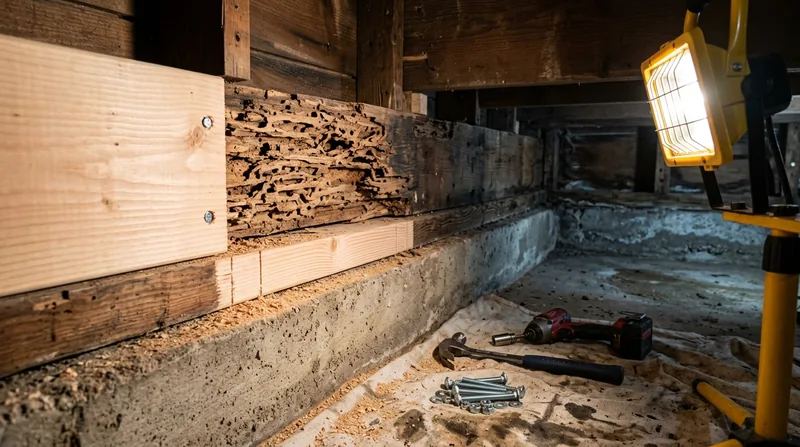




Eastern subterranean termites are quieter in Nebraska than they are in the Deep South, but they do reach the sills and basement framing of Lincoln's older homes, particularly the Queen Anne and Tudor Revival houses along the Near South and the brick ranches and split-levels of Eastridge and Meadowlane. After your pest inspector leaves and the exterminator finishes, the damaged wood remains. Termite damage repair means replacing the eaten studs, sills, rim joists, trim and subfloor sections, restoring full structural integrity so your floor doesn't bounce, your walls stay plumb, and your basement stays dry. We work from your pest inspection report, remove and replace only what termites have hollowed, and leave the rest untouched. This is carpenter's work, not pest control, and it's what keeps an older Lincoln home sound for another generation.
Why Termite Damage Repair Matters in Lincoln's Older Homes
Lincoln's residential stock is old enough and damp enough that termite damage is a real concern, especially in basements and crawlspaces where moisture lingers from the Salt Creek and Antelope Creek bottoms and where the heavy loess and clay soil keeps groundwater close. Termites don't announce themselves like a roof leak does. They work inside the wood, eating the cellulose and leaving behind a papery shell that looks solid until a joist gives way or a sill plate crumbles under the weight of a wall. By the time an inspection reveals the damage, the wood has lost much of its load-bearing strength. Repair isn't optional, it's structural.
- We remove termite-damaged studs, sill plates and rim joists and replace them with pressure-treated lumber that resists further insect and moisture damage.
- We replace subfloor sections where termites have eaten through, sistering new joists alongside damaged ones where the wood still carries some load.
- We repair or replace trim, casing and fascia that termites have hollowed, restoring the weather seal and the finished appearance.
- We document the scope of replacement for your insurance claim, helping you preserve the record of what was damaged and what we restored.
Once the damaged wood is gone and the new wood is in place, your home's frame is sound again, and the risk of settlement, bouncing floors or binding doors stops growing.
Key info: Termite damage in Lincoln is often found in basement rim joists, under porches, and along sill plates where the house meets the foundation. The damage spreads slowly but steadily, so early repair stops the problem from reaching structural beams or floor joists that cost far more to replace. See your pest inspection report carefully and call us to schedule an on-site look before the damage spreads into areas that are harder to access.
For more detail on structural wood damage and repair methods, see our page on wood rot and dry rot repair, which covers similar damage patterns and replacement techniques.
The Nebraska Department of Agriculture's pest management section offers guidance on termite identification and inspection standards: nda.nebraska.gov.
How We Repair Termite Damage in Lincoln: A Step-by-Step Approach
Our process starts with your pest inspection report and a careful on-site assessment of what the termites ate and how deep the damage goes. We don't guess or over-replace. We measure, probe, and document. If a joist is half-eaten but still sound, we sister a new joist alongside it. If a sill plate is crumbling, we remove it and install pressure-treated lumber that will resist both termites and moisture. We work in sequence, making sure the house stays stable while we're removing damaged wood and that everything is properly nailed and secured before we finish.
- We inspect and document all damage, marking what stays and what goes, and explaining the repair strategy to you before we start.
- We remove termite-damaged wood sections carefully, supporting the structure above with temporary bracing if load-bearing members are involved.
- We install new pressure-treated studs, joists, sills and rim joists, nailing them to code and ensuring full bearing and connection.
- We replace subfloor and finish wood, scribing and fitting trim so the repair blends with the original and the floor is level and solid.
- We photograph the work, collect receipts, and provide you with a detailed invoice showing what was removed and what was installed.
The goal is a repair that lasts and a floor that feels solid underfoot again, not a quick patch that will need work in five years.
Local example: A homeowner in Country Club called us after a termite inspection found damage in the basement rim joist and under the porch ledger. The rim joist was hollow for about eight feet, but the band board above it was still sound. We removed and replaced the rim joist in pressure-treated lumber, sistered the ledger to a new pressure-treated beam, and the floor above stopped bouncing. The porch is now solid and the basement stays dry. Total work took three days.
For more on the structural carpentry methods we use in termite repairs, including sistering and joist replacement, see our page on floor joist and subfloor repair.
Termite Damage Repair Methods and Materials
| Approach | Description | Best for |
|---|---|---|
| Sistering | Install a new pressure-treated joist or stud alongside the damaged one, nailed securely and sharing the load. | Joists or studs that are partially damaged but still contribute to the structure and don't need full removal. |
| Full Replacement | Remove the entire damaged member and install new pressure-treated lumber cut to length, nailed and bearing properly. | Rim joists, sill plates, and studs that are hollow or crumbling and cannot be trusted to carry any load. |
| Subfloor Patching | Cut out the damaged subfloor section, install new pressure-treated plywood or boards, and nail to the joists below. | Localized damage to subfloor where the joists below are sound and the damage doesn't extend across multiple joist bays. |
| Trim and Fascia Replacement | Remove termite-damaged exterior trim, casing or fascia and install new pressure-treated or exterior-grade lumber, sealed and painted. | Porch trim, window casing, fascia and soffit where termites have eaten the wood and weather sealing is compromised. |
| Pressure-Treated Lumber | All replacement structural wood is pressure-treated with preservatives that resist termites, rot and moisture for decades. | Any below-grade or high-moisture repair where the wood will be exposed to soil contact or dampness. |
Termite Damage Repair Cost in Lincoln: What to Expect
Termite damage repair in Lincoln starts at around $1,200 for a small, localized repair, such as replacing a four-foot section of rim joist or a subfloor patch in a single joist bay. Larger jobs, such as replacing an entire basement rim joist or multiple studs and sills, run $3,500 to $8,000 or more depending on access, the extent of the damage, and whether the repair involves load-bearing members that need temporary bracing. A few factors move the cost up or down. The size and location of the damaged area matter most: damage that's easy to reach costs less than damage hidden behind stored items or in a tight crawlspace. The type of wood and the structural role it plays also matter. A rim joist carries the weight of the wall above it, so replacement is more involved than replacing trim. Whether the damage has spread into hidden cavities or behind finished surfaces will also affect the scope and the price.
We always recommend getting two or three estimates from local carpenters you trust. Each contractor may assess the damage slightly differently, and comparing the scope and the price helps you understand what the job really costs and what's included. Our estimate is free, and we'll give you a detailed breakdown of what we'd remove, what we'd install, and what the timeline looks like.
For a full pricing overview and examples of other carpentry work we do in Lincoln, see our pricing page. Call us at (531) 229-0979 to schedule a free on-site estimate.
Termite Damage Repair Near Me: What to Look for When Hiring a Carpenter in Lincoln
Hiring the right carpenter for termite damage repair matters because the work is structural, not cosmetic. You want someone who understands how termites damage wood, who can assess what needs to stay and what needs to go, and who can install new structural members properly so your home is sound again. Here's what to check before you hire. First, ask if the contractor is fully insured and carries general liability and workers' compensation. Second, ask for references from recent jobs in Lincoln or nearby areas, and follow up with at least two of them. Third, get the estimate in writing with a clear description of what's being removed and what's being installed, not just a lump-sum number. Fourth, ask whether the job will need a permit from the Lincoln building department, especially if load-bearing members are involved, and confirm that the contractor will pull it if required. Fifth, if you live in a historic district or have an HOA, check whether there are restrictions on exterior repairs or material choices before work starts.
- Ask to see proof of current insurance, including general liability and workers' compensation coverage for all crew members.
- Request at least two references from termite damage or structural repair jobs completed in the last two years in Lincoln or nearby towns.
- Confirm that the estimate is in writing and includes a detailed scope, a list of materials, labor, and a timeline for completion.
- Ask whether the job requires a permit and, if so, whether the contractor will handle the permit application and inspection.
- Discuss payment terms: many carpenters ask for a deposit to schedule the job, with the balance due on completion, not before work starts.
A good carpenter will answer these questions clearly, show you their work, and stand behind the repair with a warranty on labor. For help getting started, contact us to schedule your free estimate.
Termite Damage Repair in Lincoln: Pricing Guide
| Service | Price | Details |
|---|---|---|
| Small localized repair | Starting at $1,200 | Includes removal and replacement of up to four linear feet of rim joist, or a single subfloor patch with sistering |
| Medium scope repair | Starting at $3,500 | Includes replacement of eight to twelve linear feet of rim joist, multiple studs, or subfloor sections across two or more joist bays |
| Large or complex repair | On estimate | Multiple areas of damage, load-bearing members, temporary bracing, or repairs requiring access to difficult or confined spaces need site assessment |
| Travel and access | Included | No separate travel fee for jobs in Lincoln and surrounding service areas within fifteen miles of the city center |
| Free estimate | Free | On-site inspection, damage assessment, and written estimate with no obligation, response within 24 hours at (531) 229-0979 |
Indicative pricing, the exact cost depends on square footage, finish, and site access. Free personalized estimate within 24h at (531) 229-0979.


