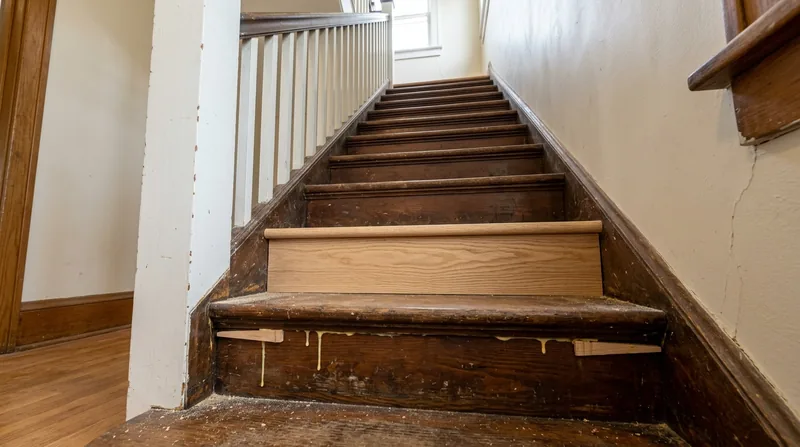




Stair & Railing Repair in Lincoln keeps the two-story foursquares, split-levels, and Queen Anne homes across the city safe and functional year after year. Lincoln's residential staircases take real punishment: freeze-thaw cycles loosen treads and stringers, heavy humidity and dry winter heat cause wood to shrink and swell, and the constant foot traffic on 1920s craftsman bungalows and postwar brick ranches wears balusters and newel posts down to bare wood. A squeaky tread or a wobbly banister isn't just annoying, it's a sign that the stringer, fasteners, or rail connection are moving. We repair and rebuild the stairs Lincoln homeowners climb every day, restore period railings on Tudor and Colonial Revival homes, and install sturdy handrails and attic ladders that hold. Our carpenters handle the full scope: tread replacement, stringer reinforcement, baluster repair and replacement, loose rail tightening, and handrail installation.
Why Stair & Railing Repair Matters in Lincoln Homes
Stairs in Lincoln houses move more than you might think. The heavy loess and clay soil beneath full basements swells and shrinks with moisture, settling center beams and bouncing joists, which ripples up through the entire frame and destabilizes stair stringers. Winter heating dries the wood, summer humidity swells it. Freeze-thaw cycles on exterior stairs and landings crack stringers and heave treads. A loose tread or railing isn't cosmetic, it's a safety issue and a sign that the fastening system is failing. Catching it early and reinforcing the connection keeps the staircase sound and prevents the kind of damage that forces a full replacement.
- Squeaky treads signal movement between the tread and stringer, usually fixable by re-fastening or shimming the connection.
- Wobbly balusters and loose rail connections develop as fasteners work loose over decades of use and seasonal wood movement.
- Worn stringers and cracked treads on exterior stairs and landings result from water exposure and freeze-thaw damage common in Lincoln winters.
- Handrail installation is often required by code on stairs with more than three risers, and we size and secure them to handle real load.
- Period railing restoration on 1920s and 1930s homes preserves original character while reinforcing the structure for safety and durability.
Addressing these issues promptly prevents the staircase from becoming unsafe and saves the cost of a full reconstruction.
Key info: Lincoln's freeze-thaw cycles and seasonal wood movement are the primary drivers of stair failure. A staircase that squeaks or sways slightly in winter but feels solid in summer is moving with the house, and the fastening system is being stressed. Repair now prevents the gap from widening into a real safety hazard.
For guidance on permit requirements for stair alterations in your area, check with the Lincoln Building & Safety Division, as requirements vary by scope and location.
How We Repair and Rebuild Stairs in Lincoln
Our approach starts with a clear diagnosis. We climb the stairs, feel for movement, examine the fasteners and connections, and trace any squeaks or sway to their source. A loose tread may need only a shim and a new fastener; a cracked stringer may need a sister board sistered alongside it to restore strength; a worn baluster may be replaced in kind to match the existing railing. We work from repair first, replacement only when the wood is too far gone or the damage too extensive. On period homes in the Near South and Country Club neighborhoods, we match the original stringer profile, tread width, and baluster turning so the repair is invisible.
- We inspect the stringer, treads, risers, balusters, newel post, and rail connections to locate the source of movement or wear.
- We tighten or replace fasteners, shim treads and stringers to eliminate gaps, and re-glue joints where wood has separated.
- We sister cracked or split stringers with new lumber fastened securely to restore the structural integrity of the staircase.
- We replace individual treads, balusters, or rail sections in matching wood species and profile to preserve the original appearance.
- We install or upgrade handrails to code, securing them to studs or stringers with hardware rated for the load.
- We finish the repair with sanding and stain or paint to blend the new wood with the existing staircase.
The entire job is planned around your schedule, and we clean up as we go.
Local example: A 1920s foursquare in Everett had a squeaky tread on the second-floor landing. We found the tread had shifted on the stringer, opening a 1/8-inch gap. We shimmed the tread, drove new fasteners through the stringer into the tread, and glued the joint. The squeak stopped, and the tread is now solid. The entire repair took one morning.
Related structural work, such as framing and structural carpentry, may be needed if the staircase is part of a load-bearing wall or if the foundation has settled significantly.
Stair & Railing Repair Methods and When to Use Them
| Approach | Description | Best for |
|---|---|---|
| Tread and fastener re-tensioning | Tighten existing fasteners, shim gaps, re-glue loose joints, and reinforce the tread-to-stringer connection. | Squeaky treads, minor movement, loose connections that have not caused structural damage to the wood itself. |
| Stringer sistering | Fasten a new sister board alongside a cracked, split, or weakened stringer to restore load-bearing capacity and stiffness. | Cracked stringers, split stringers from freeze-thaw damage, or stringers that have lost stiffness and cause the staircase to sway. |
| Tread replacement | Remove a worn or damaged tread and install a new one in matching species and profile, fastening securely to the stringers. | Treads worn smooth or splintered by decades of foot traffic, water damage to treads on exterior stairs, or rot in the tread wood. |
| Baluster and railing replacement | Remove damaged or loose balusters and install new ones matching the original turning, or upgrade to a new railing system that meets current code. | Loose or cracked balusters, split newel posts, railings that no longer meet code, or period railing restoration on historic homes. |
| Handrail installation | Install a new handrail or upgrade an existing one, securing it to studs or stringers with hardware rated for 200-pound concentrated load. | Stairs without handrails, handrails that are loose or undersized, or codes requiring a handrail on stairs with more than three risers. |
| Full staircase reconstruction | Remove and rebuild the entire staircase, including stringers, treads, risers, balusters, newel post, and rail, from the ground up. | Extensive rot or damage to multiple components, stringers too weakened to repair, or when a complete modernization is desired. |
Stair & Railing Repair Cost in Lincoln: What to Expect
Stair and railing repair in Lincoln starts at around $600 to $1,200 for straightforward work like tightening fasteners, shimming treads, or replacing a single baluster. A full tread replacement typically runs $800 to $1,500 depending on the tread width and wood species. Stringer sistering, which reinforces a cracked or split stringer, generally costs $1,200 to $2,500 per stringer depending on the stringer length and the extent of the damage. Handrail installation runs $400 to $1,000 depending on the length and the complexity of the mounting. A full staircase reconstruction, which is rare, can range from $3,500 to $8,000 or more depending on the number of steps, whether the stringers are open or closed, and whether the railing is period restoration or modern code-compliant.
The primary factors that move the cost up or down are the extent of the damage, the wood species (matching a mahogany railing costs more than matching pine), the accessibility of the staircase, and whether the repair is interior or exterior. Exterior stairs exposed to weather and freeze-thaw cycles often require more extensive work than interior stairs. Getting 2 or 3 estimates from local carpenters gives you a clear picture of the work needed and the cost range for your specific situation.
Travel is included in all estimates for Lincoln and the surrounding area, and we respond to estimate requests within 24 hours at (531) 229-0979. For a detailed breakdown of pricing by service type, visit our pricing page.
Stair & Railing Repair Near Me: What Lincoln Homeowners Should Know When Hiring a Carpenter
Hiring the right carpenter for stair and railing repair means finding someone who understands the specific challenges of Lincoln's climate and residential stock and who can diagnose the root cause of the problem, not just patch it. Look for a carpenter who has worked on the era and style of your home, whether that's a 1920s Tudor on Sheridan Boulevard, a craftsman bungalow in Havelock, or a 1970s split-level in Piedmont. Ask for references from recent jobs, and call at least two to ask about the quality of the work and whether the carpenter was punctual and professional. A good carpenter will explain the problem clearly, show you why repair is better than replacement where it is, and give you a written estimate that spells out exactly what will be done and what it will cost.
Fully insured status is essential, and you should ask to see a certificate of insurance before work begins. For any work that alters the stairs or railing, confirm whether a permit is required by contacting the Lincoln Building & Safety Division, as requirements vary by the scope and location of the work. If your home is in an HOA or historic district, check whether there are restrictions on exterior railing changes or materials. Get multiple estimates so you can compare scope, materials, timeline, and price, and don't assume the lowest bid is the best value if the carpenter hasn't clearly explained the work.
Ready to get started? Contact us for a free, no-obligation estimate, and we'll schedule a time to inspect your staircase and provide a clear plan and price.
Stair & Railing Repair in Lincoln: Pricing Guide
| Service | Price | Details |
|---|---|---|
| Tread re-tensioning and fastener replacement | Starting at $600 | Tighten fasteners, shim gaps, and re-glue loose connections on a single tread or section |
| Single tread replacement | Starting at $800 | Remove and install a new tread in matching wood species and profile, including finishing |
| Stringer sistering or reinforcement | Starting at $1,200 | Fasten a sister board alongside a cracked or weakened stringer to restore structural integrity |
| Handrail installation or upgrade | Starting at $400 | Install or replace a handrail secured to code, length and mounting complexity affect final cost |
| Full staircase reconstruction or extensive repair | On estimate | Multiple stringers, treads, balusters, and railing components require on-site inspection for accurate pricing |
| Estimate and travel | Free | No charge for inspection and written estimate, included in Lincoln and surrounding areas |
Indicative pricing, the exact cost depends on square footage, finish, and site access. Free personalized estimate within 24h at (531) 229-0979.


