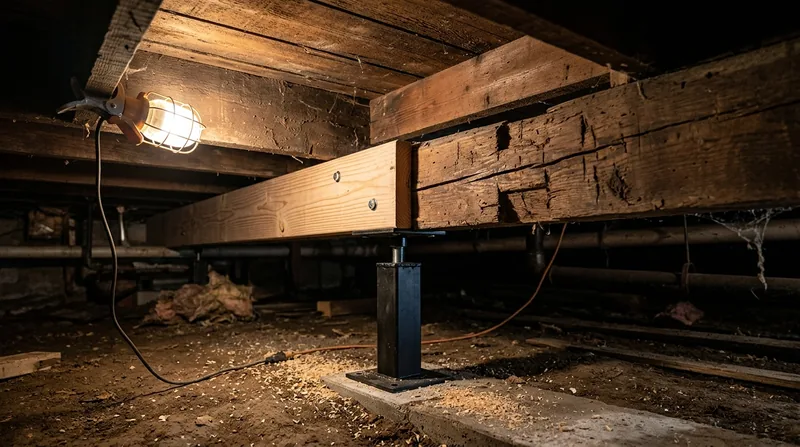




Lincoln's homes rest on heavy loess and clay soil that swells and shrinks with the seasons, and that movement settles center beams, loosens floor joists, and softens subfloors across the city's architectural stock. Queen Anne and Tudor Revival homes along the Near South, brick ranches in Eastridge, and the old craftsman bungalows of Havelock and University Place all share a common problem: floors that sag, bounce, or feel soft underfoot. Floor joist and subfloor repair is not cosmetic work. A floor that moves signals either settlement on the foundation beam, decades of plumbing notches that have weakened the joists themselves, or moisture intrusion from the damp basements that plague homes near Salt Creek and Antelope Creek. We sister or replace compromised joists, rebuild subfloor sections, and level floors before finishes go back down, stopping the movement and restoring the solid feel a house should have.
Why Floor Joist and Subfloor Problems Accelerate in Lincoln's Climate
Lincoln's hard continental climate, with hot humid summers and sub-zero January cold snaps, drives seasonal wood movement that no house escapes. The freeze-thaw cycles and heavy wet snow melt water into basements and crawlspaces. Plumbing work over decades notches joists for drain runs and water lines, reducing their depth and load-carrying capacity. The clay soil beneath the basement heaves and settles, tilting the center beam and throwing the floor system out of level. When you add moisture from below, the wood softens, loses its strength, and the floor begins to move.
- Settled center beams over shifting clay cause floors to sag toward the middle of the house.
- Notched joists from old plumbing work fail faster because their reduced cross-section cannot carry the load.
- Moisture in crawlspaces and basements near the creeks weakens wood fiber and invites rot.
- Bounce and soft spots in floors signal joists that have lost their stiffness and need replacement or reinforcement.
Catching these problems early and repairing them keeps the rest of your house from racking and binding as the floor moves.
Key info: Lincoln's basement clay and the Salt Creek and Antelope Creek bottoms mean damp crawlspaces are normal. A moisture inspection is the first step before any joist repair. Check the Lincoln building department website for guidance on moisture and crawlspace ventilation standards.
How We Repair Floor Joists and Subfloors in Lincoln Homes
We start with a walk-through to identify which joists are soft, which sections of subfloor are compromised, and whether the center beam has settled. We measure the floor with a long straightedge or laser level to quantify the sag. From there, we decide whether to sister new lumber to the existing joists, replace them outright, or rebuild the subfloor in sections. Sistering is the preferred method when the joist still has structural integrity but needs reinforcement. If the wood is rotted, notched beyond repair, or severely deflected, replacement is the honest answer.
- We inspect the basement or crawlspace to assess moisture, beam settlement, and the extent of joist damage.
- We measure floor deflection and identify which joists are load-bearing and which are secondary.
- We sister sound joists by fastening new lumber alongside the existing member with bolts and nails spaced per code.
- We replace rotted or severely damaged joists with new pressure-treated or solid lumber, sized to match the existing system.
- We rebuild subfloor sections with new plywood or solid wood, screwing or nailing it to the joists to restore stiffness.
- We level the floor before finishes go back down, so your hardwood, tile, or carpet sits on a solid plane.
The result is a floor that no longer moves, squeaks, or feels unsafe to walk on.
Example: A 1920s Tudor in Country Club had a soft spot in the hallway upstairs. We found the center beam had settled 1.5 inches, and two joists were notched for old plumbing. We sistered new joists alongside the notched members and shimmed the center beam back to near-original level. The floor is now solid, and the doors upstairs close properly again.
Methods and Materials for Joist and Subfloor Repair
The method we choose depends on the severity of the damage, the age of the house, and the cost-benefit of repair versus replacement. Sistering is fast, non-invasive, and preserves the original frame. Replacement is necessary when rot, termite damage, or severe notching has compromised the wood beyond recovery. Subfloor repair ranges from spot replacement of rotten sections to complete tearout and rebuild, depending on what the inspection reveals.
| Approach | Description | Best for |
|---|---|---|
| Sistering | New lumber bolted and nailed alongside existing joist to share the load. | Sound joists that are deflected or notched but not rotted; reinforcement without removal. |
| Joist Replacement | Rotted or severely damaged joist removed and new member installed to match existing size and spacing. | Rot, termite damage, or joists too weak or notched to repair; restores full capacity. |
| Subfloor Repair | Rotted or soft subfloor planks or plywood removed and replaced in sections or full span. | Moisture damage, rot, or movement in the subfloor layer; necessary before any finish flooring. |
| Beam Shimming | Center beam leveled with steel shims or adjustable posts to restore floor plane and relieve joist stress. | Settlement on foundation; works best paired with joist repair to address root cause. |
Lumber selection matters. We use pressure-treated lumber for joists in damp basements and crawlspaces, and solid sawn or engineered lumber sized to code for the span and load. For subfloor, we install 3/4-inch plywood or solid decking, screwed or nailed to prevent squeaks and movement.
Floor Joist and Subfloor Repair Cost in Lincoln: What to Expect
Floor joist and subfloor repair in Lincoln starts at $1,800 for a small, localized job such as sistering one or two joists or replacing a small section of subfloor in a tight crawlspace. The cost grows with the number of joists involved, the extent of subfloor damage, access difficulty, and whether the center beam needs shimming. A full floor system repair across an entire room or spanning multiple rooms can run $4,000 to $8,000 or more. The best way to know your actual cost is to have us inspect the floor and give you a detailed estimate on site.
Factors that affect the price include the size and depth of the joist system, the number of notches or damaged sections, whether the wood is pressure-treated or standard lumber, moisture conditions in the crawlspace, and how much of the subfloor needs replacement. Access also matters: a basement with a high ceiling is faster to work in than a crawlspace where we have to belly-crawl. Getting two or three estimates from local carpenters is smart practice, so you can compare scope, method, and price before you commit.
Visit our full pricing overview for more detail on how we break down costs for different repair sizes and methods.
Floor Joist and Subfloor Repair Near Me: What to Look for When Hiring a Carpenter in Lincoln
Finding the right carpenter for floor joist and subfloor repair means looking for someone who has done this work in older Lincoln homes and understands how settlement, moisture, and plumbing notches combine to fail a floor system. Ask whether they inspect the crawlspace or basement, explain what they find, and propose repair before replacement. A good estimate should itemize labor, materials, and method, not just a flat number. References from past customers in Lincoln or nearby towns like Waverly, Hickman, or Crete are worth checking.
Get multiple estimates so you can compare approaches and pricing. Ask whether the carpenter is fully insured and carries general liability coverage. Understand whether your repair requires a permit from the Lincoln building department, especially if the work involves altering load-bearing joists or replacing a significant span. Some HOA communities in Country Club or Piedmont may have additional requirements. Call the Lincoln building department or your HOA if you are unsure. A reputable local carpenter will help you navigate these questions and coordinate with the city if needed.
Ready to get started? Contact us for a free, no-obligation estimate at (531) 229-0979. We will walk your floor, inspect the basement or crawlspace, and give you a clear repair plan and price within 24 hours.
Floor Joist & Subfloor Repair in Lincoln: Pricing Guide
| Service | Price | Details |
|---|---|---|
| Single joist sistering | Starting at $1,800 | One or two joists reinforced with new lumber bolted alongside; includes basic subfloor inspection and leveling check |
| Joist replacement | Starting at $2,500 | One to three joists removed and replaced with new pressure-treated lumber; cost increases with joist length, depth, and access difficulty |
| Subfloor repair section | Starting at $2,200 | Rotted or soft subfloor planks or plywood removed and replaced; price depends on section size and whether joists need repair or shimming |
| Full floor system repair | On estimate | Multiple joists, extensive subfloor damage, beam shimming, and leveling across large areas require site inspection to size and price accurately |
| Travel and estimate | Free | No mileage fee or call-out charge in Lincoln and surrounding areas; response within 24 hours at (531) 229-0979 |
Indicative pricing, the exact cost depends on square footage, finish, and site access. Free personalized estimate within 24h at (531) 229-0979.


